In Mr. Shifty you control the titular teleporting character who pretty much looks and acts like a 8 year old kid’s idea of a cool guy in an action-packed, adrenaline-fueled, reaction heavy beat them up game that many journalists described as basically Hotline Miami but with super powers.
To their credit, the Mr. Shifty does actually play pretty similar to Hotline Miami in the sense that both games place you into a environment with a limited number of varying enemy times that you have to kill before you can proceed to the next level, but accomplishing that can be quite hard since in both games a single hit from any enemy means that you will instantly die have to restart the whole stage.
The obvious difference between the two is that in Hotline Miami the protagonist was just a regular guy with no special abilities whatsoever that has to rely on his wits, his available tools and ingenuity to murder people while Mr. Shifty is basically a superhero that is strong enough to punch through walls, can shatter concrete, can throw with incredible force, can teleport up to 5 times in a row before needing to take a breather and he can slow down time on top of all of this. This leads to a gameplay difference where in Mr. Shifty you are relying more on your super powers than purely your reflexes and skills.
The easiest way I can illustrate this through an example is by talking about walls. Walls in Hotline Miami matter a lot since they very clearly separate the boundaries between safe space and a danger zone and if you get locked into a corner with bad enemies, then you are very likely screwed since Jacket, the protagonist of Hotline Miami cannot just pass through walls, but Mr. Shifty totally can pass through them (as long as the said walls aren’t thicker than 1 meter) and you can virtually survive any dangerous situation as long as you have teleportations left.
So even though Mr. Shifty and Hotline Miami both have similar gameplay, their experiences end up being totally different. Mr. Shifty is a way more empowering game since it makes you feel powerful. Shifty’s blows can easily shatter furniture (the game has a decently destructible environment) and send enemy goons flying massive distances.
Another key difference from Hotline Miami is that you cannot use the weapons dropped by your enemies (with the exception of the Ninja’s Katanas), which at first I assumed to be because Mr. Shifty has a no killing rule or something, but that isn’t the case as he has no qualms throwing people out of skyscraper windows and impaling enemy goons to the wall with tridents. It is probable that the developers thought that the addition of firearms would make him too op.
That said even without firearms you never really feel like you are at disadvantage at any point of the game, to put it simply you are The Predator and your enemies (for the most part) are a bunch of normal people with guns that have very little chance of individually doing anything against you. They are at your complete mercy most of the time and it is very fun to hunt them down and eliminate them.
This isn’t to say that Mr. Shifty is an easy game, to the contrary, it is the opposite. If you fool around and not take it seriously you can very easily die since as I said, even a single shot from a weak pistol goon will kill you instantly and the challenge only progressively escalates and gets harder with each level. More and more enemy types and mechanics are introduced that are increasingly annoying and harder to deal with such as various traps, anti-teleportation devices that make it so you cannot teleport in a given area, more annoying enemies like flamethrowers guys and turrets with tracking missiles (which follow you even after teleporting).
Gameplay-wise I have very few complaints to make since this is a legitimately good and well put together and entertaining game, but it is far from being flawless and it has some obvious problems that become apparent to anyone who was finished the game.
The biggest and most obvious problem is padding. What do I mean by that? Well the game is short. Short enough that I completed it in merely 3 hours, but what is important about this is that I spent 2 of those 3 hours in the last like 3-4 levels or so, meaning that 90% of the content for the game can be finished in under an hour, but the last few levels artificially expand the length of the game by suddenly increasing the difficulty to the point that you cannot avoid dying several dozen times to get through them.
Before you start thinking that I’m a bad player, I have to mention that the way difficulty ramps is mostly via traps, and while traps were also present in the earlier level they were mostly designed in a way that you could still go through them with sufficient reflexes as long as you were paying attention, but in the last 3 levels traps become kind of unfair and a 1-2 second reaction delay will pretty much mean your end in many of them and passing these traps has more to do with learning their patterns rather than your own reflexes. In other words these traps were intentionally made unfair to slow down your progress and lengthen your play time.
(The reason why they might want to lengthen the player’s playtime is to get them to pass the 2 hours limit of Steam refund policy. (Steam issues free refunds for any game that you bought within 2 weeks and only played 2 hours or less) Without these padded segments the game could most definitely be completed in under 2 hours and then any player could just refund it and get their money back. Of course I have no proof that this was the actual intention behind the padding, but I have no problem voicing my suspicion.)
Laser traps are the most common type of traps
And if traps weren’t enough, these last few parts of the game have absolutely no qualms teleporting 40 or more goons into the room (since the antagonist acquires the protagonist teleporting power midway through the game) often while you still have to pay attention to the traps. In earlier levels the placement of goons were more strategic and well thought out, but in the last few levels it feels like the developer(s) just abandoned all thoughts and decided to throw as many enemies at the player as they could.
Regarding the last part I have to talk about the fact that while this game runs fine and without lag for 90% of the content on even a 10 year old potato like my machine, during these teleport half a hundred goons into the room segments my game noticeably started lagging and thus I enjoyed these parts far less than a player with a more modern machine would have.
Lastly in the last 3-4 levels the checkpoints feel more spread out and sparse than in the earlier levels, which made it so that you sometimes had to redo 5-7 minute segments every time you died, which is granted not a massive amount of time, but it still adds up over a lot of deaths, especially compared to earlier levels where dying would have only wasted you about 1 or 2 minutes of progress at most.
Hilariously after the sudden difficulty spike in the last 3-4 levels, the “final boss”, the big bad who has been trash talking you the entire game is laughably easy and can be eliminated with a single punch after evading his rather simple barrage.
The other major problem with the game is the lack of any incentive to replay it. Once you are done with the 3~ hour length play time there is pretty much nothing else to do since you don’t unlock any harder difficulties, new game + or additional maps or anything like that all that would keep you coming back for more.
Mr. Shifty also doesn’t really have a real story beyond some incredibly basic stuff that exists to move you from point A to point B, and this also only serves to further hurt the game’s replayibility, since a well constructed and multi-layered story can also create an incentive to replay the game, case in point Hotline Miami, which most people had an incentive to replay at least once to get the full picture and gather all the puzzle pieces needed to unlock the true ending.
Given the short length of the game and the absolute lack of replayability I really wouldn’t recommend buying this game for 15 euros, it is a good game, but it isn’t worth that price. At the very least I would expect a 10 hour long play time for that price, but Mr. Shifty just gives you a 3 hour experience for 15 euros that also feels intentionally padded out. Fortunately I grabbed it when it was like 90% on some site so I didn’t pay the full price for it, and I would advise potential buyers to do the same.
Knights of Honor Deceit is a game that can be best described as Medieval Total War – II on speed and crack cocaine, because it plays almost exactly the same as MTW – II except everything is 10 times faster, with the only substantial difference from MTW – II being the fact that the strategy map is also real-time (but pausable) as opposed to turn-based.
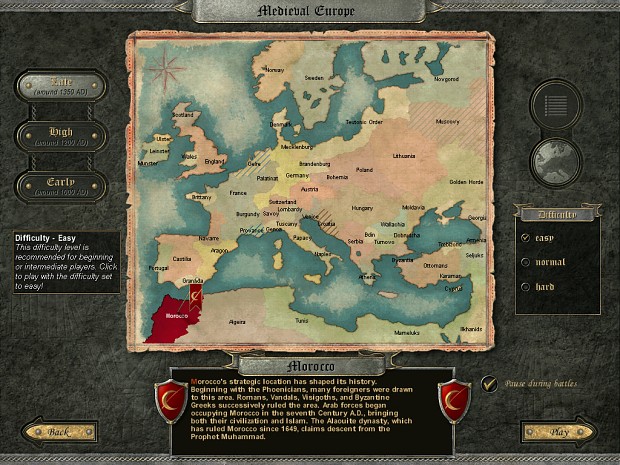
Selection Screen
In Knights of Honor you can play as one of several dozen medieval nations from 3 time periods: Early Medieval Period (1000), High Medieval Period (1200) and Late Medieval Period (1350). It actually matters very little what period you choose to play in because technology doesn’t change or evolve in Knights of Honor, which means that you will be using the same units and buildings regardless of the time period you play in.
The only relevant impact the chosen time period has on your gameplay is that the starting conditions for the various nations, as well as the nations themselves are different for each time period.
For example: If you choose to start in the Early Medieval Ages (1000) then the Byzantines are pretty much a super power and a major influence in Asia, while if you start in 1250 then the Byzantines are considerably weaker due to the historical effects of the 4th crusade and the partitioning of the Byzantine Empire.
Also, if you want to play as factions that historically came into play later, such as the Teutonic Order or the Crusader States, then you obviously cannot play them in the Early Medieval Ages because they didn’t exist yet. If you want to play with the most amount of nations then choosing to start in 1350 is probably the best idea since it has the largest amount of factions from the 3 time periods.
Unfortunately there is pretty much no meaningful difference between any of the nations beyond the aesthetics. All of the nations have the same buildings and all of the nations use the same units (except for the 1 unique special unit that each nation gets), so it matters very little which nation you end up choosing because your experience is pretty much going to be the same regardless of your choice.
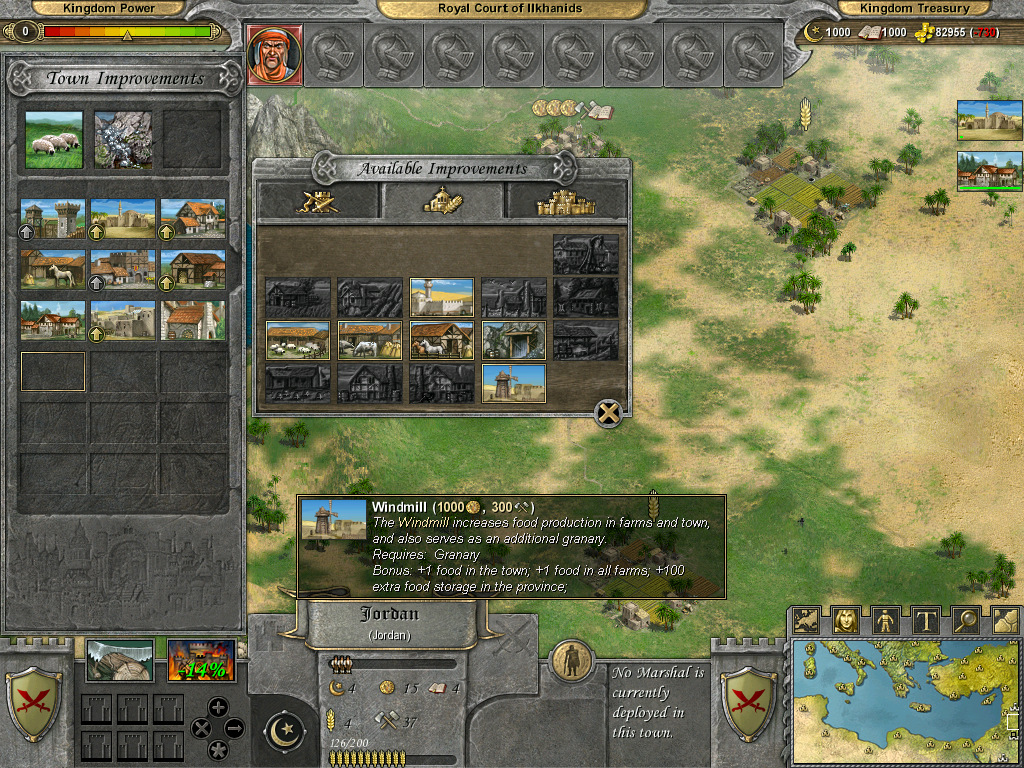
Strategy Map and Town Development
While the user interface in Knights of Honor may look confusing at first glance, it is actually really simple once you figure it out, and if you are really lost there is well made a 20 minute long in-game tutorial explaining all the important mechanics of the game, but I believe that Total War players will feel right at home and know exactly what to do once they have gotten the hang of the UI.
While the in-game tutorial is great, for some dumb reason it doesn’t tell you that PageBreak is the pause button and that you increase and decrease the game speed with the + and – buttons respectively, which is something important, considering you will use these buttons the most after your mouse buttons.
Like many strategy games, most of your time in Knights of Honor will be spent looking at a map, which is fortunately very nice and pleasant looking in KoH with tons of aesthetic details, moving objects and life as opposed to the extremely dull, dry and boring maps that are typical of grand strategy games. It also helps that KoH has some pleasant atmospheric music that draws you into that medieval feel and immerses you somewhat in the role of a medieval ruler.
The gameplay pretty much consists of perpetually upgrading your towns into either money making industry powerhouses, massive military headquarters that can pump out advanced units or special resource producing havens (more on this later) and waiting for stuff to happen while your towns are being upgraded. But you really don’t have to wait long since events happen like lightning in this game and the usual course of things is that you will be drawn into war in about 3-4 minutes of starting the game by one of your neighbors, if you didn’t start one yourself by then.
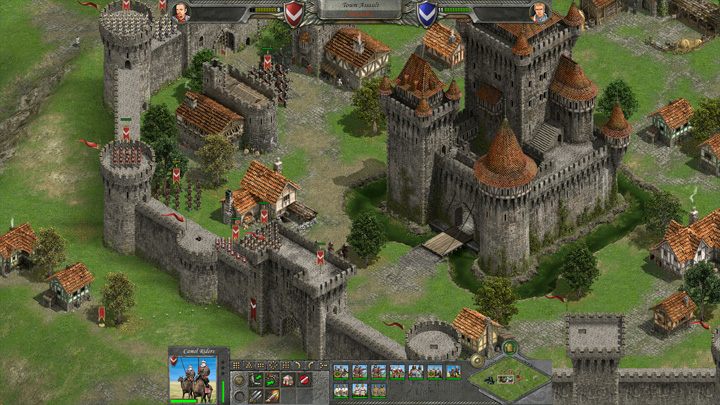
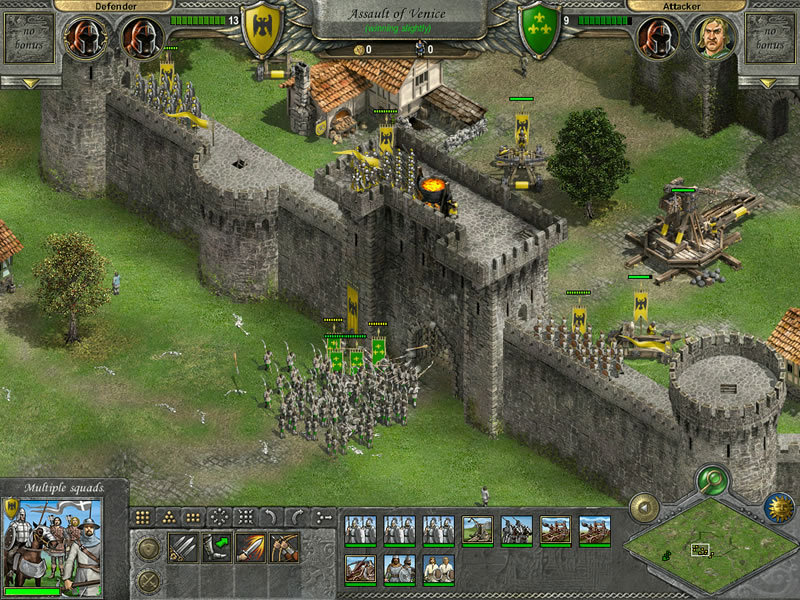
Battle Graphics
Once you are in a war you can experience the other major part of the gameplay, that is the battles, by making contact with enemy armies or towns.
Battles in Knights of Honour are concluded extremely fast, usually 2-3 minutes for the average battle, but if you really want to, then you can possibly stretch this out to 10 minutes I guess, but you really won’t be fighting any long or prolonged battles that can happen in Medieval Total War II here, there are no 30-minute long siege battles or anything similar.
Due to the short time-frame of the battles and the fact that squads tire out extremely quickly (there is a stamina system) there are very limited opportunities for complicated tactical maneuvers. Your standard battle in Knights of Honor usually consists of 1 big engagement that tends to last a minute and then finishing off the stragglers in another minute or two, though this can extended by several more minutes if the enemy or you has reinforcements. Battles can also instantly be ended if you kill all the enemy commanders (the marshals), which is the quickest way to win a battle, since killing them will cause all other squads to flee and give up.
As you may have already grasped, Knights of Honor is an extremely fast paced game and that is probably it’s appeal, since you don’t need to commit to massive battle sessions like you do in Total War. Knights of Honor is a game that is extremely easy to pick up and play for 5 or 10 minutes every now and then, as opposed to other strategy games that require a larger time commitment and more attention.
You will be fighting short but numerous battles in quick succession and the state of the game progresses really quickly. In your standard vanilla game, entire kingdoms will already be wiped from the map after the first 20 minutes of you starting the game, and after a few hours the in-game map will be reduced to a couple of super powers battling it out over the resources.
The AI is very aggressive in the game and will constantly declare war on everyone including you, because of that you will rarely ever spend much time at peace if any at all, especially since other Kingdoms are more likely to declare war on you if you are already at war with someone else, leading to chains of war declarations, but this also applies to the AI Kingdoms and not just you. It isn’t unusual to see an AI Kingdom be at war with 3 separate nations at once.
Winning the game can be technically accomplished in 3 different ways, but in actuality only 1 of them is realistic.
Conquering all the other factions
Getting voted as Emperor of Europe by all the major powers
Acquiring all the special resources and unlocking all the Kingdom Advantages
Option 1 is not viable, because it is too time consuming and a chore, since once the powers of Europe have been consolidated into 2-3 super powers, then fighting them will be a genuine pain as they will be less likely to fight other nations and be distracted (which is constantly the case in Early to Mid game, hence why conquest is easier then). Later game empires have a much easier time consolidating their forces and focusing all of them on a war with you, so conquering them can take ages especially because of the massive amounts of territories they can hold.
The Voting
Option 2 requires you to be voted as Emperor of Europe by the other major powers, which will realistically never happen because you need positive relations with most of the AI nations to be voted, which is quite the autistic task in a game where the AI is a chronic backstabber that couldn’t care less about your alliances and marriage pacts, and will happily break them whenever. You really have to go out of your way to have an amicable relationship with most of the powers.
Option 3 is the only realistic win condition for the simple reason that you don’t have to go out of way to achieve it, instead you pretty much complete it just by playing the game normally. Kingdom advantages are acquired by gaining access to all the trade resources that are needed to unlock them, which you gain by upgrading your towns or by conquering your rival’s upgraded towns, which are both things you do anyway. In fact if you conquer about 1/4th of Europe then you will have unlocked pretty much 90% of the trade resources for your Empire and will be very close to victory, so the conquest victory condition is quite pointless due to this fact.
Assisting you in your quest to world domination and victory are your loyal and not so loyalKnights, which makes up the most important aspect of Knights of Honors’ gameplay. Without knights you cannot even do anything except upgrade your cities, as knights are needed to lead your armies as commanders and without them you cannot even mobilize your army or launch attacks towards enemy nations.
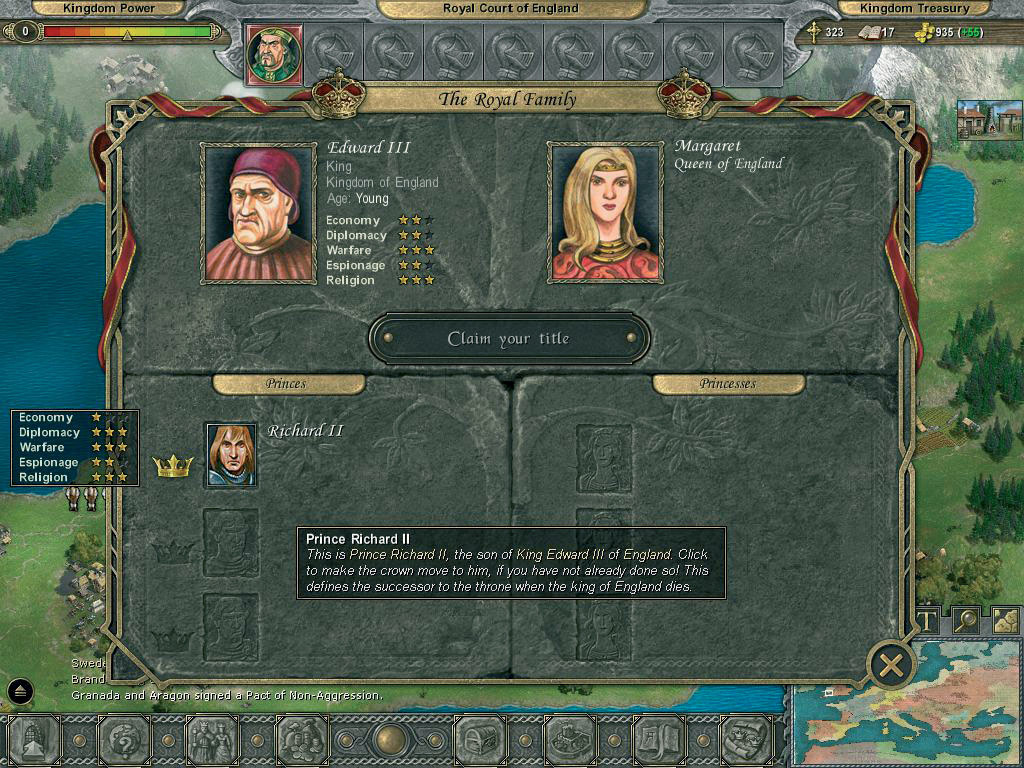
The Royal Family
Before explaining the duties and all the roles of Knights, I must first go over the fact that knights can be your own sons or complete strangers that you hired as mercenaries to serve you, which is quite an important detail, considering the fact that in this cursed game if you hire a knight, they are 100% guaranteed to be a spy from one of your rival nations. You cannot know where they came from or who they serve, but they will fester in your court, endlessly scheming and plotting for decades while pretending to be completely loyal and never doing anything out of place that would draw your ire, until you decide to a attack a kingdom that you weren’t at war with before, after which they will promptly betray you because you just attacked their nation, and their betrayal can range from mild annoyances like having your money stolen or having your entire army turned into rebels who will now proceed to ravage your lands, and major annoyances like having entire cities (along with all their garrison and resources) suddenly defecting to the enemy’s kingdom.
To illustrate just how ridiculous spy shenanigans can get, allow me to tell you one of my very first experiences with them:
I was having some trouble with foreign populations constantly rebelling, so I had hired a knight and made him into a cleric to quell and convert the local populace, which he had successfully done without dying (Clerics can be killed while converting). This cleric lasted so long in my service that he had outlasted my first King and went on to become the Pope without ever arousing any suspicion or being ousted out as a spy, then several years later I declared war on a Kingdom and the Pope, who should have been under MY control suddenly excommunicated me…because the goddamn Pope was a spy all along.
Realistically speaking, you shouldn’t trust any of your knights except those of your own bloodline and the 1 free knight you start the game with (he will never be a spy). The problem however is that you cannot avoid using hired knights because your sons are precious and most of the jobs knights can do are hazardous, and you generally do not want your heirs to die and cause a succession crisis because you suddenly have no heirs due to the fact that some asshole with a pitchfork stabbed him while he was converting a town.
Managing your entire court of spies and assigning them to jobs that will damage you the least if they decide to stab you in the back is not only an essential part of Knights of Honor but also the most challenging and hardest part of the game, unless of course you have no qualms about save-scumming, in which case it’s a joke mechanic because you can just reload after a betrayal to a previous point in time and unassign the spy from his job before the betrayal, but playing like that just turns an already super easy game into a braindead game.
Knights can do several jobs in Knights of Honor but only 4 of those jobs are actually viable and the rest are a waste of a court slot (you can only have a limited number of knights). The four viable jobs are the following:
Marshal – Essential – Trains troops, Leads Armies, Becomes a Napoleon/Alexander the Great tier monster general once upgraded
Cleric – Essential – Governs cities, Lowers unrest in governed cities, Converts different cultures, Converts different religions, Generates book resource, Can become the Pope
Merchant – Essential – Early game they are the primary source of your income and some nations wouldn’t even be able to get going without them (if you start as Armenia in 1000 for example then you might have a -3 income by default, but by securing a trade contract with the Byzantines you can raise that income to 50 with a single merchant) They lose their value Mid game as generating money becomes trivial, but they are useful Late game because they can secure trade resources you are missing for your victory.
Spy – Not essential but viable nonetheless – Can send them to enemy Kingdoms as knights, gives you intelligence and info regarding the Kingdom, can tell them to betray the Kingdom the same way AI spies can betray you. Realistically takes them too long to be hired into an enemy Kingdom, so I rarely use them, but they can definitely be powerful if they get going.
Since you can only have 9 knights in your court at any given time, I have found the ideal distribution to be a minimum of 3 Marshals, 2 Merchants, 2 Clerics and 2 free slots for prisoners (prisoners take up a court slot for some reason) or a 4th Marshal if needed.
Since I have introduced all the major gameplay elements, it’s time to address the big elephant in the room:
Is the game any fun?
Yes…for the first few hours when you have no idea what you are doing and your own ignorance provides the challenge.
Knights of Honor has a crippling problem, and that problem is that the game is ridiculously easy, once you’ve learned the mechanics of the game and played for 2-4 hours then absolutely nothing will stop you from abusing the mechanics of the game and completely stream-rolling the AI. I don’t consider myself a competent strategy player, if anything I consider myself bad or subpar based on my Starcraft multiplayer experiences, and even in my very first play-through of this game I controlled all of Northern and Western Europe after 6 hours, as Wales…
You can easily wage 3-5 wars at the same time and it won’t even affect you. Why? Because the AI is pretty much brain-dead and can only beat you if they outnumber your army 3 to 1, but sometimes even then they will manage to lose because the AI is simply that incompetent. There are numerous ways the AI’s incompetent and the game’s lack of challenge shows, so allow me to elaborate:
Firstly, conquering provinces is trivial and can be accomplished with very little losses and very little effort. Most of the time all you need to do to conquer an enemy province is to march your army next to the enemy border, declare war, march to the enemy town, take the poorly defended enemy town, sign for peace and rinse and repeat until you are a massive empire.
To explain why the above is so easy to do: It’s because the AI is constantly at war, so their armies are almost never at home but instead at the front-lines of whatever nation they are fighting with, so the only thing protecting their town are garrisons (6 squads max) + town guard if they built the necessary building, and taking over a town defended by only that is trivial since they don’t have marshals to boost the defending army’s morale and stats and because of the fact that the AI often can’t handle defensive battles, like at all.
I don’t understand what exactly causes the AI to do it, but they often send out their armies out of the castle to assault you,when they are on the defensive side, and whenever they do that, it’s pretty much a guaranteed instant-loss for them because your armies can just grind them down as they slowly come out of the gates. So even if the AI has built massive fortresses to protect the city, it can mean absolutely nothing because the AI is suicidal and behaves aggressively even in a defensive battle.
And that’s just the tactical map AI. The strategy map AI is even more braindead, because after taking a single town you can instantly white-peace with them in 99% of the scenarios and keep the town you’ve just taken.
It doesn’t matter if you are a small irrelevant nation like Armenia with only 1 or 2 provinces and they are a massive giant like the Byzantine Empire with several dozen provinces, they will still white-peace you and let you keep the town even though you’ve never even fought an actual legitimate battle with their armies.
The strategic map AI is fundamentally incapable of calculating the value of peace deals and will always accept white-peace after you’ve taken a single town regardless of the context or the situation, but hilariously if you actually crush their armies and wage wars for years then they won’t accept perfectly reasonable peace demands like having their princess marry your prince.
Once you are aware of how the AI thinks and behaves, then you can pretty much just take provinces every 5 or 10 minutes with 0 losses and grow a massive empire with very little effort, but the stupidity of the AI doesn’t end here.
Let’s take the opposite scenario: The AI attacking player, and the player being the defender.
If the battle is an open battlefield then the AI will just march towards your army without any special formations and charge towards your troops when they get sufficiently close, but if you have archers then the AI will have a mental breakdown and constantly run back and forth without engaging your troops allowing you slowly whittle down their number until your archers run out of arrows, and when they do finally engage then any 5 year old commander could easily flank and surround them because they absolutely don’t bother defending their sides, and this is pretty much every open field battle in a nutshell.
If the battle is a siege where the player is a defender then the AI will handle it just as incompetently as their defensive siege battles. After they break down your gates and send maybe 1-2 troops in to be slaughtered the AI has a tendency to break as usual, which will cause them to just stand there doing nothing, staring at your castle walls endlessly and not moving any of their troops, which forces you, the Defender to assault them because they refuse to assault you, which is absolutely bizarre, but it does happen and I have no idea why the AI breaks so badly in this game.
Regardless of the type of battle, in both cases the AI has a habit of ordering their Marshal into the middle of the battle, where it can be quickly ganged upon and killed by a horde of peasants, which will instantly cause them to lose the battle due to the lack of available commanders.
Outside of the AI’s horrible decision making, the game is further dragged down by its horrible balance.
The Peasant Meta:
It is fairly common for medieval strategy games to have peasants as the cheapest and lowest tier unit that you can create, but unlike other strategy games, in Knights of Honour peasants are not only the cheapest unit but also the most viable unit.
You see in Knights of Honour you need 3 things to produce troops:
Money – Which you will eventually have so much that you don’t know what to do with it. The higher tier the unit, the more money they’ll require.
Food – Which you will always have a limited amount of because they are stored in towns and produced by towns and every town only has a limited storage for food, and you cannot store an infinite amount. The higher tier the unit, the more food they’ll require.
Various buildings – Such as spear-maker for spear-men, bowyer for archers, stables for cavalry etc. The higher tier the unit, the more buildings are needed for them to be creatable.
Peasant’s fall outside the norm because they only need the first 2 and can be produced in any town, and not only that, but they also require virtually no money and the least amount of food. But why does this matter, you might ask?
Well, you see in KoH unit production is instantaneous, the moment you click on the icon, they are instantly produced and placed in the city, which also obviously means they are instantly usable, and this little fact enables the player to pull off some absolutely dumb but very effective strategical maneuvers that wouldn’t be possible in real life:
Such as attacking an offensive enemy army marching onto your town/territory and inflicting as much damage as possible to the enemy then retreating with your marshal, then commanding your Marshal (who has maxed out mobility skill) to go back to the town and immediately hire another full army and attack the enemy army again, rinse and repeat until the enemy army is either vanquished or completely useless by the time it arrives at your town.
If your Marshal has the maxed out mobility skill then he can repeat this maneuver potentially 3 times before the enemy army could even reach your town, but where do peasants come into the picture? This whole defensive maneuver is basically impossible with anything but the peasants, because you can only produce like 2-4 higher tier troops before completely depleting your town’s food storage, so the lowly peasant who only asks for a couple dozen gold and 50 food is the only valid candidate for this extremely powerful defensive strategy since you can train around 2 entire armies worth of peasants without your town running out of food.
The usefulness of peasants are further amplified by the fact that their stats are actually not that much worse than higher tier units, and 2 troops of peasants can confidently beat any 1 troop of higher tier unit. The only real downside to using peasants is that they have a naturally low morale, which can be completely fixed and negated by using a charismatic marshal with maxed out leadership, which will pretty much turn your army of ragged nobodies into a credible and effective military force.
Knights of Honor is probably one of the few games where you can conquer Europe with nothing but peasants.
In comparison to peasants, the other units are really just not worth the hassle, especially since they have costly requirements and take up a building slot or two in your town, which could be used to make money or produce special resources instead.
Swordsmen honesty feel like they are just a more expensive but higher morale peasants, Spearmen are only good for their ability to counter cavalry (which the AI tends to charge headlong into your formations), Cavalry is technically decent but it is way too expensive to buy early to mid game and AI is sure to fill their army with spear-man anyway, which hard counter them, but the worst of the worst are the Archers.
While I talked earlier about how Archers can break the enemy AI, I neglected to talk about the fact that they are in fact the worst unit in the game despite that fact.
Anyone would think that a horde of unarmoured peasants could be mowed down by a troop of archers rather easily, but that isn’t what happens in this game at all, in fact the Archers can barely do any damage to the unarmoured peasants, I would say that 1 archer volley takes down about 5% of a peasant troop, which is ridiculously low when they should absolutely wreak havoc on such easy targets.
Not only do Archers have piss damage but they also come with LIMITED ammo supply, which generally doesn’t even last half the battle forcing you to send them into melee combat as extremely poor melee units, unless of course you have a Marshal with maxed out skill in Archery, which allows them to have double the ammunition and actually make them viable for a full battle, but the fact that you need to invest 3 skill points into one of your marshal into just making them viable proves that you really shouldn’t bother with them.
And speaking of marshals, let’s continue with them:
Marshals: Walking Demigods
Marshals, your commanders are objectively your strongest assets in Knight of Honor, in fact losing an experienced Marshal is a bigger loss to your Kingdom than losing 2-3 towns. Why? Because, you see in Knights of Honor, everyone except but the active Kings and the active Pope are immortal and will never die of old age, which means that the longer a Marshal lives, the more powerful he becomes, eventually he will accumulate so many skills that he will be a walking legend capable of winning almost any battle, your very own Alexander the Great, except this Alexander will never die and forever conquer at your hands (unless he is a spy).
Hilariously, there is nothing easier than keeping your Marshal alive, since the moment you press the “retreat” button in battle he is automatically safe and his return will be guaranteed, even if he was surrounded by enemies on all fronts and about to be killed when you pressed the button, because Marshals are just so divine in this game that they can teleport out of the battlefield at will.
But let’s be serious here for a moment. Marshals are badly implemented because their skills are absolute bullshit op effects which range from simple stuff like +3 permanent morale to your troops (completely negates the morale penalty of peasants), -3 permanent morale to your enemies’ troops (completely trivializes any rebellion since rebels have low morale by default), to absolute retarded effects like recovering 70% of your battle casualties after every battle, allowing you to keep attacking and attacking like a madman and increased movement on the strategic map for your army, which allow your army to move so fast, that you can blitzkrieg 3 towns before the enemy army even comes back into their own borders, and since Marshals will realistically never die, they will only accumulate more and more of these skills until they become absolutely powerful and game breaking.
Unfortunately the AI is pretty much incapable of benefiting from this system, since as I have mentioned earlier they will have 0 hesitation about marching their marshals into the middle of death and having them killed, so their marshals will always be inexperienced nobodies and I have never noticed any of the skills being active when fighting them.
Sadly, Knights of Honour is a ridiculously easy strategy game that will offer you no challenge whatsoever once you figure out its mechanics and how it works, and I must mention that it didn’t take me days or anything longer to have these observations, I was already aware of them after a mere 6 hours of playing, with my first nation.
So why should anyone play this?
Essential for playing Knights of Honor
Because the “Ultimate Edition – Full HD and Complete Mod Pack” exists, which adds tons of essential and quality life changes to Knights of Honour and also fixes the game-play somewhat by tweaking the balance and economy. In fact this mod is so good that there is literally no reason to play the game without it, the vanilla version is just objectively inferior to it and going by the comments on the mod and on Steam, a lot of people seem to agree with me.
The best thing about the mod is that it comes with an easy to use installer, so even if you know nothing about modding you can install it trivially like any other program.
I was genuinely having a much harder time with the mod despite still using all the dirty tricks I learned from vanilla. Conquering definitely feels a lot harder and slower. To illustrate: my first play-through with the mod I was still only at 5-6 towns and didn’t even move out of the Middle East yet (I was playing as Antioch) after 4-6 hours of playing, while in vanilla as I have already mentioned ruled most of Europe by that point with my first nation.
From what I noticed the AI starts with upgraded cities and higher tier units from the get go, which definitely make it harder for you to conquer them, add in the fact that all the unit costs including the cost of peasants have been raised significantly, suffering losses in the early game is actually impactful now. Peasant’s also felt a lot less powerful than in the base game and while they were still useful I actually felt compelled to upgrade to higher tier units, unlike in vanilla. Unfortunately the mod doesn’t seem to fix anything about the game’s braindead AI, but at the very least it fixes some of the game’s massive balancing issues and makes it playable.
To summarize: Knights of Honour is a beautiful, well presented, fast paced real time strategy game most similar to Medieval Total War II, that has a horrible AI and is pretty much unplayable in its base form due to its horrible game balance, but should you choose to mod it, it will turn into a legitimately entertaining strategy game for you to have days of fun with.







 Eggplant Club