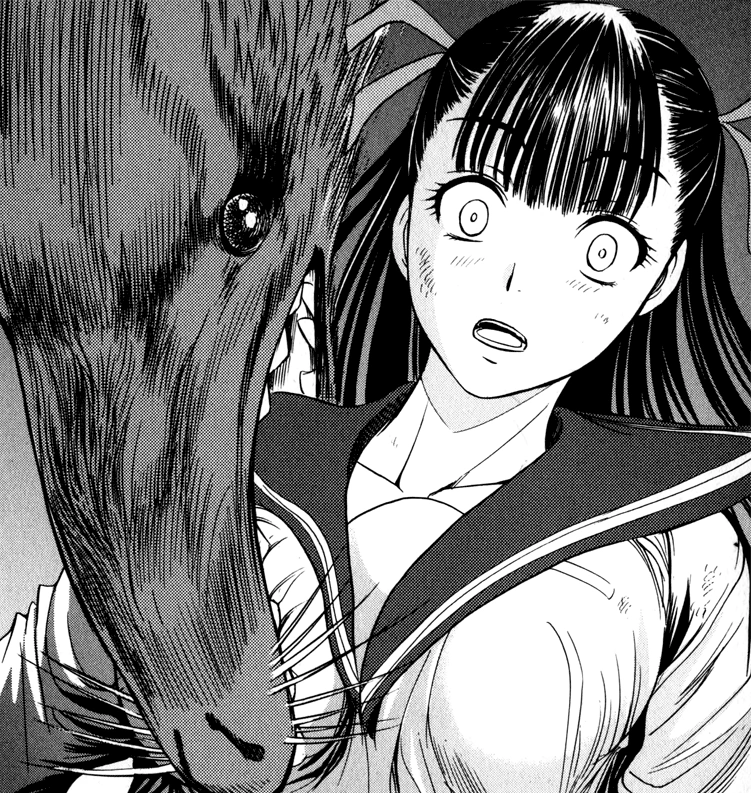
A three episode 1989 OVA adaptation of an 18 volume long manga that published between 1987 to 1991, Umi no Yami Tsuki no Kage is a story about identical twin sisters, Rumi and Ruka who survive the exposure to an uncovered burial ground in a cave with deadly gases that kills every one of their classmates present but grants the twins superpowers that correspond to the cycles of the moon. One of the sisters, Rumi goes insane after she wakes up and decides to stop at nothing to acquire the boy both sisters like, Katsuyuki-kun even if it means killing anyone that stands in her way, including her sister.
The premise of this anime is fairly interesting and is what caught my attention while browsing for stuff to download, but unfortunately the anime is a lot more underwhelming in practice. There is no progression to Rumi’s insanity for example, she just faints from the cave incident and when she wakes up she is already an insane psychopath willing to use her newfound powers to whatever she decides. The other characters are not any better as they can be most generously described as horror movie stupid and make the dumbest decisions possible, worst of all they don’t take Rumi with the seriousness the situation would deserve until she has already killed a lot of people.
It is also definitely not the best looking OVA I have watched, it does not look ugly or anything necessarily, but I did find some of the visual effects weird like how Rumi turns entirely blue when using her powers or the funny way the characters just stiffly floated in the air and did this awkward hovering while chasing the other characters.
Worst of all is the fact that the anime does not conclude things as obviously the manga was still not finished at the time it was made and as such nothing is really resolved. You basically have a large portion of the town being mind controlled like puppets by Rumi (it is one of the powers she has) and the anime just ends with basically Katsuyuki daring her to take his life if she wants him so much saying “she can have his body but not his heart“, and to which Rumi actually chickens out and runs away as the anime closes without either having dealt with her or the puppets.
So why should anyone watch this? It is very short about an hour long with all 3 episodes if you don’t include the openings and endings, so the basic interest of the premise is more than enough to last you for that hour before you would get bored by it, also it has this dumb 80’s horror feeling going for it which can be appealing to you, it is the kind of anime that in many ways becomes more entertaining by its flaws, such as the dumbness of the characters contributing to entertainment. There are far worse choices if you are looking for some dumb movie length anime entertainment.
Freesia is a weird and surreal psychological action manga by Jiro Matsumoto following mostly the adventures of a mentally insane legally sanctioned bespectacled vengeance killer called Kano. The manga is fairly violent and has scenes that can range from disturbing to disgusting so it is definitely not for everyone, but those with some tolerance and the stomach for it will definitely find an enjoyable dark story here.
Premise: Freesia is set in an alternate history Japan where people are legally obliged to avenge the death of their loved ones if another person kills them, and seeing that trying to kill another person would be a highly dangerous thing for the average person to do, the majority of people opt to instead hire professionals who deal in revenge killings and enacting vengeance on the behalf of their client as proxies. The story basically centers around one such agency that is in the business of revenge killing people and follows several characters who work there. The premise is actually pretty interesting already on its own, but it is just surface level compared to the actual meat of the manga, that being its characters and the things they undergo throughout the course of story.
Story: The manga in the beginning follows a series of revenge killings that are carried out by our main characters, and as expected things start out fairly simple but they escalate with each new mission. These tasks are narratively really just excuses to have our characters go through increasingly traumatic experiences and have said experiences mold and change our characters, with all of the sanctioned killers ending up in a different direction in response to said traumas. Saying anything more of Freesia’s story would be spoiler material in my opinion, but I shall mention that it gets weirder and more surreal the longer it goes on and at some point it will abandon all sense of normalcy as if the manga and the story were seemingly breaking down along with the deteriorating mental health of our characters, and you will be left with an ending that will have you questioning what was even real in the manga.
Characters: Freesia at its core is a psychological manga so the primary focus is naturally on the characters, the story easily comes second in this case as it really is just a vessel for the manga to do it characters exploration. If you are the kind of voyeuristic sadist who enjoys watching broken and miserable characters wail around in life then you will feel right at home, because Freesia will provide exactly that. There are a number of characters all with their complexes and issues, but for the sake of brevity and for the sake of avoiding as much spoilers as possible I will only talk of Kano, the primary protagonist.
Kano is one of those rare characters that make it worth recommending their story just for them alone, he is easily the best part of Freesia and is also one of the most entertaining portrayals of an insane person I’ve seen. From the start of the story he is already very obviously mentally ill to the reader, but he is still functional enough to just get by in his daily life without being seen as such by the other characters, who instead view him as a mild mannered kind of guy that they wouldn’t think twice of after bumping onto him on the street, while his co-workers don’t take him seriously as a vengeance killer.
At his home we see just how dysfunctional he truly is as he often does not pay much attention to his vegetative state mother or the girlfriend he is living with, instead he is often concentrated at completely different things like the television or a phone that only he can hear and at one point in the story it goes so bad that the girlfriend cheats in front of him just to try and elicit a reaction from Kano. Even outside of his home and when seemingly functioning well in society it still never feels like he is operating on the same level as the other characters, his mind is always in his own world and he is just going through the motions of a normal conversation. This “being on another level” only escalates as the manga goes on and overtakes the story too as the other characters will quite literally become unable to even touch Kano and he transforms into a truly terrifying entity that cannot be understood.
Of course given that our protagonist is insane that is just one way of viewing the story and you can always bring in the unreliable narrator angle as the more the story focuses on Kano’s viewpoint the more unreal things get and if we take things at their face value then bullets really just pass through Kano as if he wasn’t even there when no other character display such seemingly magical abilities. It is entirely probable that we are seeing events as through how Kano imagines them rather than how they actually happen and there are several hints for this to be the case.
In any case, watching Kano’s progressive descent into even deeper layers of madness than what he had at the start is one of the most entertaining parts of Freesia and will no doubt fascinate readers whose interest it has managed to arouse.
Action: A significant portion of Freesia is compromised of action sequences and there is a lot of gunfighting and even some melee close quarters battles, and all of them are done pretty well. Jiro Matsumoto did a good job on making his fight scenes remain suspenseful and thrilling for most of the manga, even Kano was fairly vulnerable and suffered injuries at the earlier points of the story, The combat is also quite visceral and feels real with bullets often leaving the characters full of holes and even taking out entire chunks out of the injured bodies, though it never got to the point where I felt it was too much or too exaggerated to be taken seriously, so it was in good balance. Action sequences involving Kano were often filled with fits of insanity or delusion, which just made them even more entertaining.
Art: The manga’s art overall is not the best for sure, it is probably the category I can praise it the least amount for and it often looks a bit rough and uneven but it is kind of fitting for its story in a way, and there some moments in it where the art is chillingly good, these occur at some pivotal emotional moments in the story and do a really good job of drawing you into the moment and the feelings it wants to convey, but those only work as well as they do because the manga does not usually look that good in my opinion.
The manga’s art at its best
Conclusion: Freesia while it is definitely not for everyone it is one of the best Psychological action manga you can read with well done action sequences and interesting exploration of its characters and their psyche, because of this it deserves my strongest recommendation.
Eden no Ori is a 185 chapter long manga published between 2008-2013 that could be easily called the Lost of the manga medium. The story involves a bunch of kids suffering a plane crash onto a mysterious island where all sorts of weird things happen and the more they explore the more bizarre things they find, the survivors are forced to work together and try to survive their new environment lest they perish. The manga utilizes the ‘mystery box‘ effectively to keep the readers interested and glued to its pages and it is actually pretty entertaining and suspenseful to read for most of its chapters, however when it nears the end and the time comes to answer all the piled up questions the answers will most likely leave you unsatisfied, and to pour salt on the wound the ending of the manga is more of a bait for a sequel that never happened rather than a proper ending.
Metal Skin Panic is a single episode 1987 OVA anime that I recommend comfortably finishing while you are having dinner or lunch seeing it is only 40~ minutes long. The story is rather straightforward involving a teenage boy who has gotten trapped in a prototype mech suit known as Madox-01 and also has to comically meet his love interest later that day before she goes overseas, which prevents him from just turning himself over to the authorities, meanwhile the authorities are obviously trying to recover their dangerous and experimental military property, in particular the Japanese side wants to get it back intact while the hotblooded american tank commander wants to defeat it over a grudge of having lost to it previously during the demonstrations.
Like the basic situation the presentation is also mostly humorous and lighthearted with scenes like the protagonist asking to have his mech suit refueled at a gas station or crashing into a convenience store only to order takeout food. The only time the anime gets somewhat serious is when the protagonist battles the relentless tank commander. Being an OVA the anime holds up pretty well both in terms of visuals and animation, with there being some really gorgeous mechanical shots, which is certain to be a treat for the fans of the genre.
It is definitely a solid and entertaining watch, but unfortunately nothing more than that, which is why you probably didn’t hear a lot of people talk about this OVA, it is entertaining but nothing groundbreaking or amazing. In my opinion it could have been so much more if it was a bit more serious, since what we have in this anime is a pretty unique situation, which is essentially an inversion of the usual mecha anime premise that is random teenagers boarding super elite unsecured mechas to save their hometown/friends from whatever danger present. Instead in Metal Skin Panic there is no conflict, the protagonist gets into the mecha by complete accident and he is the one who causes the conflict with his carelessness and dumb behavior, with the antagonists merely being the military who just want to recover their valued asset that really shouldn’t be in civilian hands albeit with differing goals.
The protagonist is easily the “bad guy” from most viewpoints as while his determination to meet with his girlfriend before he runs out of time is admirable and romantic, it is also very foolish given his perilous situation of being encased in a giant suit of metal that he can neither leave nor operate efficiently, the results of pursuing his goal are obvious: He endangers the lives of all the civilians in Tokyo as well as causes a crapton of property damage wherever he goes, and this is before the military even shows up, because after that the damage rapidly escalates due to the protagonist resisting arrest with deadly force due to him not willing to compromise. Yet despite the idiocy and reckless disregard of other people’s lives and properties neither the story nor any of the characters condemn the protagonist and the screen just progresses to the credits after he has met up with his girlfriend as if everything was fine, when in reality he will be most likely taken prisoner or worse seeing he blew up 2 helicopters and killed an American tank commander on top of wrecking large parts of Tokyo.
This could have been an anime that successfully stood the test of time in more than just visuals (as it definitely still looks good to this day) if it just took itself a little more seriously, but instead its forgettable and half serious storytelling ensured that it never went beyond popcorn status.
Fallen Enchantress is a 4x fantasy strategy game by Stardock Entertainment. While not a bad title by any means and the game is playable just fine, the highest praise I can give to it is just “average” as just like there is nothing particularly wrong with it there is nothing particularly unique or innovative in the game and every feature it possesses has been done better elsewhere. That said a beginner or a newcomer into the genre could find it good and enjoy it just fine, but as for me the whole time I was playing it I was constantly thinking things like “damn I would much rather play Warlock Master of the Arcane right now” or “meh, Age of Wonders did this so much better” so I don’t think that a lot of experienced 4x players would enjoy this title.
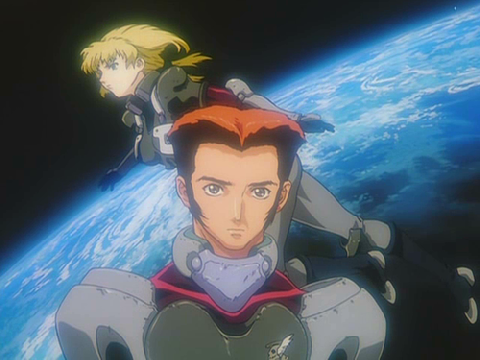
Zegapain is a 2006 sci-fi mecha anime from studio Sunrise that is often completely glossed over when looking at anime from that particular year, but unlike other cases of obscure anime this one’s obscurity is something that I can completely understand as Zegapain is not only not made for the average anime watcher but is also pretty hard to get into given how slow the initial episodes are and how it takes about 5 episodes for the plot to really start going.
So why should anyone watch Zegapain?
To put it very simply Zegapain has a very good story that can carry the entire anime on its own once you manage to get into it even despite the clear flaws that it has. Zegapain has characters but none of them are particularly memorable beyond the role they play in the story and the experiences they go through (which are actually memorable). Likewise Zegapain has action and fight scenes but it is the very dull kind of action that is solely carried by the stakes it has in the story and also feels very dated by today’s standards, lacking flashy visuals or impressive and smooth animation. I’m not exaggerating when I say that Zegapain is an anime that is solely to be watched for its strong story, but it is entirely because it is so strong in its plot that even talking about it can ruin the experience via spoilers. Nevertheless I have chosen to spoil the basic premise (which is only revealed around the 5th episode) to get the dear reader to give Zegapain a try.
So what is Zegapain about?
The Fake Premise
Initially Zegapain presents itself as a fairly generic mecha that follows standard literary devices and storytelling in the media: You have an average highschooler, Kyo Sogoru living an average highschool life whose average and normal highschool life is suddenly interrupted and shaken up with him meeting with a mysterious woman, Shizuno Misaki that only he is capable of perceiving. This woman convinces Kyo to become a mecha pilot for an organization known as Cerebrum to pilot a machine known as Zegapain to defend earth against the alien invaders (this part is initially presented as a video game/virtual reality). The basic premise feels intentionally mundane and by the books and it isn’t until the viewer is already a few episodes in that Zegapain truly reveals its hand:
The Actual Premise
At the start of the story humanity has already been long since wiped out and Kyo, Shizuno and all the other characters appearing in the story are nothing more than memories of humans uploaded onto a giant computer that is simulating their everyday life, a desperate last attempt by the old humanity to keep “humanity” going by whatever means possible even after they are gone. The mecha battles and fights that were initially presented as a game/simulation are in fact very real, as the forces that erased humanity are actively seeking to wipe out this remnant of humanity and the only defense these uploaded memories have against this threat are the robots known as Zegapain that are their only real way of interacting with the real world.
Kyo’s realization and subsequent stages of denial at the fact that his life and everyone else in it is not real, or at least nothing more than a digital existence are some of the best scenes in the anime and very well explored. The flaws of the digital world that is simulating everyone’s existence is also pretty chilling and well thought out, with the Server not having enough memory to continue the simulation forever, so it always just ends up resetting itself back to a certain point, making the digital people live a loop-like existence, save for the initiated who are guarding them like Kyo, which brings further despair to the protagonist, as he remains in the know while his friends are constantly reset including the experiences they shared.
But sadly I think the average anime watcher who just randomly picks this up will have already dropped the anime before they could even arrive at this point, which is exactly why I’m spoiling it.
One of the best things about Zegapain is how seriously it takes itself and likewise how seriously it treats the audience. It is a truly hard sci-fi story that doesn’t hold your hand or coddle you like many other anime do by constantly having things spelled out for you. That said I feel the need to stress that Zegapain isn’t anything pretentious or “super deep” if that is the impression that you thought I was going for. No, Zegapain has themes and messages obviously, but they are themes and messages that practically anyone can understand concerning basic existential questions and human drama, which are explored very well, and it never feels like it is too far up its own ass.
Honestly even talking of the story any further would just ruin your potential experience and I think I already said enough to entice the potential viewer to watch it, so I’ll bring this article to a close.
Zegapain has a story that basically anyone who cares about humanity or the fate of humankind to any degree can get enthralled by, provided that they get through its seemingly bland and raw presentation and the hurdle of the initial episodes.
A not scary horror manga following the misadventures of a young highschooler who can see ghosts and sense the paranormal (via nosebleeds). It is rigidly structured in an episodic formula where a new story is started each chapter and concluded within the same chapter. Its biggest problem, the lack of an ability to create any kind of suspense or tension can be most likely attributed to this episodic treatment, as by the time you realize something scary is happening it’s already over. The recurring characters suffer from chronic idiocy, shoutout in particular to the girl who almost got sacrificed by some Lovecraftian Cult and decides to found an occult club and investigate more spooky stuff instead of being scarred for life. This and coupled with the fact that each of the chapters was solved by the protagonist’s ghost girlfiend solving whatever problem was in the chapter lead to me to dropping this manga somewhere in the second volume.
Time Recoil is a fairly standard fast paced top-down shooter with an utterly basic story: Evil mad scientist dictator, Mr. Time took control of Europe, you have to stop him by traveling through time and accomplishing objectives in the past, but mostly just killing a bunch of dudes. The game itself takes you throughout the lifeless and uninteresting maps consisting of nothing more than offices, more offices, the warehouse of offices and some occasional research labs sprinkled in, which are populated by the same 3 enemy character models (technically there are more, but half of them are just color-swaps) while constantly playing the 2-3 music tracks they made for this game.
Mechanics
Time Recoil’s unique gimmick centers around time and time related powers, namely when you shoot any of the enemies, time slows down for a certain amount of time and killing additional enemies will add more duration to this counter, and when you kill 2 or more enemies you will be able to perform a ‘dash’ an instantaneous limited range teleport that gibs or stuns any enemy you teleport into. There are other abilities in the game too such as the psy blast and the complete time stop, but these are the only two abilities you will be using 99% of the time.
Power Problems
The idea behind the gameplay itself is solid however the implementation is bad. Let’s start with something I already mentioned: powers. Technically you have 4 distinct abilities that activate automatically or can be activated by the player after accumulating kills, these are as follows:
Time Slow – Automatically activates after killing any single enemy and at 1 kill it barely lasts like 2~ seconds, further kills however extend the duration
Time Dash – Can be activated after killing 2 or more enemies, an instantaneous, short range teleport that can be used to kill or stun enemies. Using it cancels Time Slow unless you kill people with it.
Psy-Blast – Can be activated after killing 6 or more enemies, an instantaneous ranged area of attack that will kill or destroy anything in range. Using it cancels Time Slow unless you kill people with it.
Time-Stop – Automatically activates after killing 8 enemies. Stops time completely for a short duration.
Kills are marked by the skull icons around the character in a circle. The remaining Time Slow is marked by the full white of the circle, which quickly ticks down.
Now the problem comes from the fact that the single most useful ability in Time Recoil is Time Slow due to the fact that enemies in this game have godly reactions and godly aim plus on top of this your character dies from a single glazing hit even if it comes from a pistol, which means you always want Time Slow to be active otherwise you can easily die to even the most basic enemy in the game, but unfortunately this means that you get to use the other 3 a lot less, because using any of them will instantly cancel Time Slow and allow bullets to catch up to you and penetrate your character’s body.
Time Dash is useful for any general bad spot or when you want to do things faster (there are several maps where it completely lets you bypass content by going through walls or mines) and the most useful thing about it is that it doesn’t expire, so if you kill 2 enemies, you will always have 1 Time Dash stored up until you use it, this unfortunately doesn’t apply for Psy-Blast which doesn’t get stored up and you have to use it in a limited amount of time if you want to make use of it, and aiming it is kind of a pain, especially when bullets are still traveling quite fast in slowed time, but probably the worst thing about is that once you get enough kills for it, it just supplants Time Dash, meaning you can’t use Time Dash because now you have Psy Blast and you have 0 control over this (because they are on the same button) even though Time Dash would be more useful in 99% of the situations.
Time Dash’s range is marked by an arrow. It especially useful and versatile due to its ability to allow the character to go through walls.
Time-Stop sounds like it should be something awesome or powerful, especially since it is really hard to get the amount of kills for it (most rooms are populated by 2-4 enemies and the kill count disappears quite fast between moving from rooms to rooms) but in actuality it is more of an annoyance than a boon, mostly because of the fact that bullets don’t travel at all in this state, which is of course logical, but it also means that bullets you fire in stopped time won’t kill the enemy until time resumes itself, which means that when time resumes itself the enemy will be still alive for a brief millisecond before the bullet hits them and that will be more than enough time for the god-tier reaction enemies to kill you with a well aimed final shot just before they would be hit by your bullets. The simple fact that it automatically activates (no player control again) makes it a very unreliable power at best.
Other Problems
If the issues with Time Recoil had ended with only at the powers then I might still consider it a good game as the gunplay in slowed time is still really fun and entertaining, but unfortunately the problems only accumulate the longer you play the game.
RNG and Weapons: Every mission starts with a pistol start (which has 8 bullets) but other weapons (Shotgun, SMG, Rifle, and Rocket Launcher) can be picked up on the map or be dropped by enemies, but the drops by the enemies are completely randomized and whether you get lucky or unlucky with the drops can lead to a completely different experience with the mission because the weapons aren’t equal: The shotgun is arguably worse than the pistol due to its small ammo count and is only situationally useful, the SMG is straight upgrade to the pistol, the Rifle is a gamebreaker, while the Rocker Launcher is so rare that I only got to use it twice in my play-through.
The above is pretty important due to the fact that while weapons do not carry between missions, they do carry between maps of the same mission (missions can be compromised of multiple maps), so if you get lucky and pick up a rifle and carry it to the next map, then you can have a super easy time on many of the maps and completely cheese through them. But why is that so? You might be prompted to ask. Well that’s because the rifle in this game for some reason can shoot through walls and through multiple enemies, it is completely awesome and also completely unbalanced because it means that you can just kill enemies through the walls before they could do anything due to your top down view granting you vision of them, but enemies with the same rifle cannot do the same because they require direct vision to fire at you. Even without time powers involved the player and the NPCs aren’t equal when using the same weapons.
Enemy Variety: To be fair there are several types of enemies ranging from simple gunmen to rocketeers to shield guards to armoured grenadiers etc. But the problem is that the game uses them in horrible proportions, the rocketeers for example barely show up while the grenadiers become scarce shortly after their introduction, while the standard gunmen are everywhere and the shield guys get overused in the later stages (to pad out the content because they are immune to almost everything but Time Dash) and in general it feels like there wasn’t much thought behind the enemy placements on the maps. The enemy upgrades also weren’t really logical, for example why did they make an entirely separate grenadier enemy (who is completely powerless beyond the ability to throw grenades every few seconds) instead of just giving grenades to the normal enemies on top of their already existing weapons? That would have been a lot more dangerous than the most trivial enemy in the game.
Environments: Earlier maps in the game are a lot more enjoyable because environments are more interactive and fun due to the fact that they are more destructible, while later levels limit the player’s freedom by populating everything with indestructible walls, essentially removing one of the tools that was at the player’s disposal from the start (and also looked awesome). The game also has glass walls, which enemies (and you) can shoot through, but because of the graphics and how everything almost looks the same, it is very hard to notice them while playing until you died to some goon shooting you through the window. Many of the later maps in particular are more or less designed in a way to kill you a bunch of times before you learn their layout to successfully navigate and cheese through them.
Padding: Like many other short games, Time Recoil falls to intentionally trying to pad out its game time by making the later levels substantially harder without proper escalation, it does this by throwing piles and piles of enemies at you (these are often endless in the later levels meaning they will keep coming until your accomplish your objective), having 80% of the enemies be compromised of shield soldiers (immune to gunfire from the front), non destructible walls and laying every path with mines to slow down your progress. All in all it leads the later levels feeling more like a chore since every bullet counts and even the tiniest mistake will be punished, at these stages it ended up feeling more like Time Recoil was some kind of flashy puzzle game rather than a proper action game.
Mr. Time
Trivial Boss: The whole game was about trying to catch the Mad Scientist, Mr. Time, trying to discover his secret location and kill him in the past to prevent his reign of terror in the future. He was built up as a huge threat that entire countries bowed to and a super genius, but despite that when you finally arrive at the final confrontation he isn’t anything special, just a dude with a gun, and lots of armour, no tricks, no schemes, barely any traps, no special time powers, just a dude with some armour that can be easily killed in less than a minute once you figure he is stunnable via time dash (stunning him 2 times and emptying your magazine into him will do the job) or when you find the conveniently placed rifle on the map that can just shoot him through the walls. Not only is the boss underwhelming but is not even a fitting one considering he ends up chasing you like some kind of terminator with a machine gun rather than a mad scientist who is characterized by their genius.
The Final Level can be completed in less than 30 seconds.
Nitpicks: If you stand close to a wall or a door, you will not be able to fire your weapon for some reason, which is probably the hardest thing to get used to Time Recoil because most of the time you are assaulting rooms from doors and if you stood too close to it while it was opening, you will not be able to fire your weapon for like a few milliseconds, which matters a lot because your enemies can fire at the same time, granted this mostly happens if you approach a door while hugging a wall, but it is nonetheless a really annoying feature.
Conclusion
A mediocre top down shooter that is actually pretty fun to play for about the first half when it is still novel and the slow-mo gunfights are still enjoyable because the game isn’t throwing piles and piles of crap on you as a pretense of difficulty, ultimately I think Time Recoil is brought down by failing to properly balance its game mechanics especially on the time powers’ front and the intentionally padded second half that was just made to extend the length of an already short game, though I must applaud it for actually having some replay-ability via 3 difficulty modes (1 of which only unlocks after beating the game). You can have some quick fun with this game, but I definitely wouldn’t buy it for the 14 Euro prices it goes on in steam though.
A “horror” manga by Umezu Kazou that despite the often horrifying and gross imagery I found more comedic than scary, mostly because of how ridiculous it was. A series of 5 disconnected disturbing stories are centered around a young boy, Shou who has the all powerful ability to omnipotently wish away whatever bad happened in the story via his magical hands but only when the plot demands him to. The characters portrayed in the stories are all unrealistic and don’t act with an ounce of common sense, often employing idiot logic instead. The one good thing I can say about it is that its artwork is almost masterful, but unfortunately I wasn’t able to take the manga seriously after reading its absurd first story.
It was just announced that Muv-Luv Alternative is getting an anime adaptation, and since with my divine clarity I can easily tell that an adaptation of a 50+ hour long visual novel is definitely going to be nothing short of a disaster, I instead decided to write about what I considers to be the closest thing we’ll ever get to a good Muv-Luv anime, and the best thing about it, it has absolutely nothing to do with the Muv-Luv franchise, I’m talking about the anime, Blue Gender.
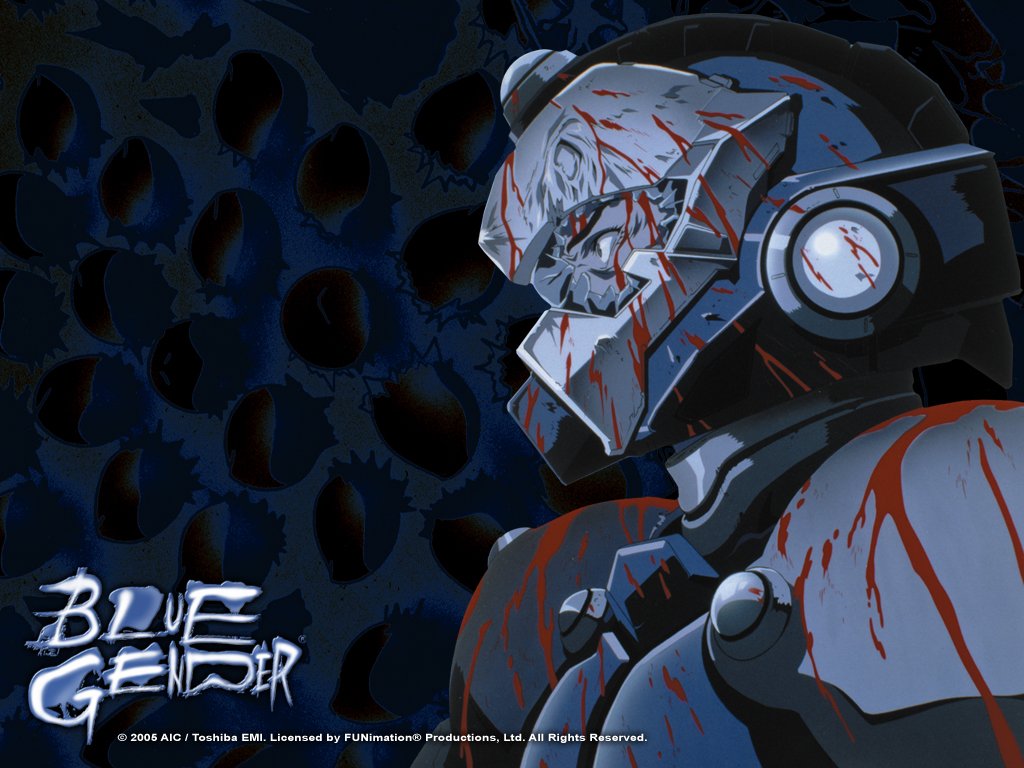
Blue Gender is a 26 episodes long 90’s sci-fi mecha drama anime that is completely anime original (not based on any preexisting source material). But why am I recommending this title specifically to Muv-Luv fans? There are a multitude of reasons for that, so let me go over them one by one.
The Premise
Blue-Gender and Muv-Luv Alternative have nearly identical premises and settings: In both works humanity is pretty much screwed and are no longer the dominant species on the planet, as humans are risking extinctions at the hands of an alien force The Blue (Blue Gender)/The Beta (Muv Luv Alternative), in both works humanity has developed mechas to combat the alien menace, but despite this advancement in technology there still doesn’t seem to be any hope for humanity initially in either of the works.
The adversaries, the Blue and the Beta are also nearly identical, both of whom are aliens lacking in any humanity both in appearance and personality, in which they are more bug-like rather than anything else as they live in hives, have various strains/types that do specific jobs/tasks and obey a hive-mind instead of having any sort of individuality. Both the Blue and the Beta also transform Earth and the geography and recycle material as their central goal, even turning captured humans into material.
The only real difference in the setting of the two works lies in the matter of how screwed humanity exactly is in their respective works. In Blue Gender humanity has been pretty much forced out of Earth by the Blue and now exist in a gigantic space station orbiting Earth known as Second-Earth where they occasionally launch futile attempts to try and retake the Earth and accomplish specific objectives, which would initially make it seem like humanity is more screwed in Blue Gender than in Muv-Luv, since in Muv-Luv humanity at least still holds some degree of control over the Earth in larger areas (such as America) and haven’t been forced off the planet just yet, but it is actually the opposite.
From a purely objective/statistical standpoint humanity is much more screwed in Muv-Luv Alternative for a number of reasons. The most obvious being that the Beta also have colonies on Mars and the Moon, so even if they wipe out the Beta on Earth they will still have to deal with the Beta on the other celestial objects, in contrast in Blue Gender the Blue are not capable of interstellar travel and as such are entirely confined to Earth, humanity would only need to wipe out the Blue on Earth somehow to achieve victory, or they could just stop wasting resources trying to retake Earth and make Second-Earth their permanent home since the Blue cannot get there. Nevertheless the fact that humans have been exiled from Earth gives Blue Gender a much more depressing tone from a sentimentalist standpoint.
The Main Characters
The protagonist of Blue Gender, Kaido Yuuji and the protagonist of Muv-Luv, Shirogane Takeru are fundamentally identical in their roles as both of them are out of time and out of place characters in the setting of the story that know nothing about the horror of the worlds they were just put into and as such serve as the crutch for the audience as someone who they can relate to in the story. In Yuuji’s case he was diagnosed with a terminal illness and put into stasis until a cure could be found in the future, but little did he expect to be awoken in a world dominated by the Blue. In Takeru’s case he was pulled from an alternate parallel dimension from his peaceful everyday life into the terrible world of Muv-Luv Alternative. The methods of arrival are different, but both protagonists are essentially foreigners to their settings.
Both main characters undergo a similar character journey where they witness the horrors of their new worlds first-hand and initially try to cope and deny their respective tragedies but eventually they are broken by it, and from that state both characters manage to rise and emerge into a new person with stronger and more resolute character than before that is capable of shouldering their role in the story.
The settings of both Muv-Luv and Blue Gender turn their otherwise ordinary protagonists into saviour figures that can grant hope to an otherwise broken world and hopeless humanity, and in both cases this happens through something that the protagonists bring from their previous ordinary life. In Muv-Luv Takeru obviously brings back Yuuko’s calculations from his old world to the Alternative world’s Yuuko, which enables her to complete the 00 Unit. While in Blue Gender, ironically the same disease that put Yuuji into stasis in the first place is sought after by the humans of Second Earth as a salvation against the Blue menace.
Structure and Tone
While Muv-Luv Alternative undergoes a lot more stages than Blue Gender does, owing to the fact that it is a 50 hour long visual novel with a lot more scenes compared to the 10 hour long Blue Gender anime, the frightening fact remains that if we examine Muv-Luv Alternative’s structure from Marimo’s death then it will be frighteningly identical to the structure of Blue Gender, in which both could be loosely characterized by the following stages that are connected by the same type of emotion present:
Despair – Marimo’s Death and Shirogane’s PTSD/Yuuji’s awakening and first 10 episodes on Earth
Hope – Shirogane’s recovery and the activation of Unit 00/Yuuji’s arrival on Second Earth and the formation of the anti-Blue strike force.
Triumph – Both Muv-Luv Alternative and Blue Gender have humanity triumph over the Beta/Blue in (a) major battle(s) in the first time since forever
Despair – The Beta/Blue make their counterattack and attack the headquarters for the human offensive, inflicting massive causalities, all seems lost.
Desperation – In both works the characters manage to defeat the attacking Beta/Blue, but their losses are too great, causing the humans to change up their plans that ends up with both Yuuji and Shirogane attacking the hive of the Blue/Beta.
Truth and Hope – During the hive attack both Yuuji and Shirogane communicate with the hive mind and learn plot related answers that change everything that happened in the story. Both stories end on a relatively hopeful note as Shirogane’s sacrifice brought humanity decades of time while in Blue Gender the humans who have learned to love are no longer hunted by the Blue.
My expression may be a bit poor, but I do believe that the overall structure of these two works are uncannily similar and that anyone who has finished both works can agree with me to some extent.
As for the tone of the works, while they are for the most part pretty similar, it has to be stressed that Muv-Luv’s gloom and doom is counterbalanced with scenes of lighthearted humour and the banter between the various colourful characters, which makes it much easier to consume compared to Blue Gender which takes itself super seriously in every episode and as a result can be a bit oppressive to watch, especially if binge-watching it. Blue Gender doesn’t really have any comedic or humour scenes to break up the tension, instead the romance between the main characters is used to tone down the constant despair and violence, but even that is used sparingly.
The Theme of Love
Everyone knows that love is a pretty important part of Muv-Luv, likewise it is also of significant importance in Blue Gender. The two main characters’, Yuuji’s and Marlene’s developing romance throughout the course of the story is one of the most pivotal aspects of Blue Gender’s message. Soon after Yuuji awakens in the future, the viewer is presented with the fact that love has ceased to exist among the humans that are struggling to survive, and even sex, the act of making love has become a cold and emotionless process meant to provide nothing but instant gratification.
In a sense, it is Yuuji who brings love back to humanity from his old world with his old world sensibilities by warming up the initially cold, super serious and stern Marlene and making her fall in love with him throughout their journey to Second Earth, however in the second act of the story the reverse happens as Yuuji starts losing his humanity due to the corrupting influence of the Blue, it is Marlene’s love that pulls him back from the depths and saves him from insanity, in essence both main characters heal each other throughout the course of the story and become people that genuinely need each other, and as they learned to love, they will be among the ones spared in the end.
Differences
While Muv-Luv and Blue Gender are pretty similar works, there are still some differences in the two that I must mention.
One of the biggest differences is in regards to Cast and Characters, Muv-Luv has a large and colorful cast that are full of life and are very likeable to the reader because they were built up for 3 visual novels (or even more if you count the non-Muv-Luv VN characters like the Kimi Ga Nozomu Eien cast) and their presence really helps creating some lightheartedness in an otherwise serious and often somber story.
In contrast only two characters really matter in Blue Gender and they are Yuuji and Marlene. There are other characters beyond them sure, but it is first and foremost their story and other characters pretty much only exist to support or oppose their journey. I would argue that this is not really a flaw but rather than asset to Blue Gender as it makes these two characters much stronger, but it also has the effect of making the viewer less invested in the fate of other characters and the tragedies that happen to them. The fact that Blue Gender is told from a 3rd person’s perspective rather than Muv-Luv’s 1st person perspective also contributes to the viewer being overall more detached and less involved from the events of the story than while reading Muv-Luv.
The second notable big difference and one that actually makes Blue Gender somewhat infamous is the fact that Blue Gender compared to Muv Luv, is quite preachy. It clearly has messages and it has no qualms wearing those messages openly on its sleeve, and its message is something many or most viewers might not agree with it and is also something that might detract from the enjoyment of the story depending on the personality of the viewer.
I don’t want to go into full detail because it would spoil the story, but humanity is painted in quite a bad light in Blue Gender, everything that happens to them in the anime is their own damn fault and even in the face of Armageddon humanity hasn’t managed to put aside their petty differences, their worst traits are on full display instead, and when humanity actually starts making successful victories against the Blue, it is framed in such a way that is meant to make the viewer kind of pity the insectoid Blue as they are portrayed completely helpless for the first time in contrast to the humans that are portrayed as bloodthirsty and savage who are losing their humanity through their victories, as if saying that if humanity were to triumph over the Blue they would become something even worse than them.
One might even simplify it that the moral of Blue Gender is “NATURE GOOD. TECHNOLOGY BAD.” and given how the story ends that isn’t even a hard conclusion to reach and while Muv-Luv also had its messages sure they certainly weren’t in any way preachy about it nor were they this unsubtle in the delivery.
Conclusion
Blue Gender is definitely one of a kind mecha anime that I think is a great treat to both fans of the genre and fans of Muv-Luv Alternative due to the similarities of the two works, though some aspects of Blue Gender such as its preachiness and its controversial ending may be a bit hard to forgive or stomach for the average viewer.
If you are going to watch it just make sure to watch the TV series and not the movie (Blue Gender Warrior), because that one is just an awful summary compared to the TV series.