Metal Skin Panic is a single episode 1987 OVA anime that I recommend comfortably finishing while you are having dinner or lunch seeing it is only 40~ minutes long. The story is rather straightforward involving a teenage boy who has gotten trapped in a prototype mech suit known as Madox-01 and also has to comically meet his love interest later that day before she goes overseas, which prevents him from just turning himself over to the authorities, meanwhile the authorities are obviously trying to recover their dangerous and experimental military property, in particular the Japanese side wants to get it back intact while the hotblooded american tank commander wants to defeat it over a grudge of having lost to it previously during the demonstrations.
Like the basic situation the presentation is also mostly humorous and lighthearted with scenes like the protagonist asking to have his mech suit refueled at a gas station or crashing into a convenience store only to order takeout food. The only time the anime gets somewhat serious is when the protagonist battles the relentless tank commander. Being an OVA the anime holds up pretty well both in terms of visuals and animation, with there being some really gorgeous mechanical shots, which is certain to be a treat for the fans of the genre.
It is definitely a solid and entertaining watch, but unfortunately nothing more than that, which is why you probably didn’t hear a lot of people talk about this OVA, it is entertaining but nothing groundbreaking or amazing. In my opinion it could have been so much more if it was a bit more serious, since what we have in this anime is a pretty unique situation, which is essentially an inversion of the usual mecha anime premise that is random teenagers boarding super elite unsecured mechas to save their hometown/friends from whatever danger present. Instead in Metal Skin Panic there is no conflict, the protagonist gets into the mecha by complete accident and he is the one who causes the conflict with his carelessness and dumb behavior, with the antagonists merely being the military who just want to recover their valued asset that really shouldn’t be in civilian hands albeit with differing goals.
The protagonist is easily the “bad guy” from most viewpoints as while his determination to meet with his girlfriend before he runs out of time is admirable and romantic, it is also very foolish given his perilous situation of being encased in a giant suit of metal that he can neither leave nor operate efficiently, the results of pursuing his goal are obvious: He endangers the lives of all the civilians in Tokyo as well as causes a crapton of property damage wherever he goes, and this is before the military even shows up, because after that the damage rapidly escalates due to the protagonist resisting arrest with deadly force due to him not willing to compromise. Yet despite the idiocy and reckless disregard of other people’s lives and properties neither the story nor any of the characters condemn the protagonist and the screen just progresses to the credits after he has met up with his girlfriend as if everything was fine, when in reality he will be most likely taken prisoner or worse seeing he blew up 2 helicopters and killed an American tank commander on top of wrecking large parts of Tokyo.
This could have been an anime that successfully stood the test of time in more than just visuals (as it definitely still looks good to this day) if it just took itself a little more seriously, but instead its forgettable and half serious storytelling ensured that it never went beyond popcorn status.
Zegapain is a 2006 sci-fi mecha anime from studio Sunrise that is often completely glossed over when looking at anime from that particular year, but unlike other cases of obscure anime this one’s obscurity is something that I can completely understand as Zegapain is not only not made for the average anime watcher but is also pretty hard to get into given how slow the initial episodes are and how it takes about 5 episodes for the plot to really start going.
So why should anyone watch Zegapain?
To put it very simply Zegapain has a very good story that can carry the entire anime on its own once you manage to get into it even despite the clear flaws that it has. Zegapain has characters but none of them are particularly memorable beyond the role they play in the story and the experiences they go through (which are actually memorable). Likewise Zegapain has action and fight scenes but it is the very dull kind of action that is solely carried by the stakes it has in the story and also feels very dated by today’s standards, lacking flashy visuals or impressive and smooth animation. I’m not exaggerating when I say that Zegapain is an anime that is solely to be watched for its strong story, but it is entirely because it is so strong in its plot that even talking about it can ruin the experience via spoilers. Nevertheless I have chosen to spoil the basic premise (which is only revealed around the 5th episode) to get the dear reader to give Zegapain a try.
So what is Zegapain about?
The Fake Premise
Initially Zegapain presents itself as a fairly generic mecha that follows standard literary devices and storytelling in the media: You have an average highschooler, Kyo Sogoru living an average highschool life whose average and normal highschool life is suddenly interrupted and shaken up with him meeting with a mysterious woman, Shizuno Misaki that only he is capable of perceiving. This woman convinces Kyo to become a mecha pilot for an organization known as Cerebrum to pilot a machine known as Zegapain to defend earth against the alien invaders (this part is initially presented as a video game/virtual reality). The basic premise feels intentionally mundane and by the books and it isn’t until the viewer is already a few episodes in that Zegapain truly reveals its hand:
The Actual Premise
At the start of the story humanity has already been long since wiped out and Kyo, Shizuno and all the other characters appearing in the story are nothing more than memories of humans uploaded onto a giant computer that is simulating their everyday life, a desperate last attempt by the old humanity to keep “humanity” going by whatever means possible even after they are gone. The mecha battles and fights that were initially presented as a game/simulation are in fact very real, as the forces that erased humanity are actively seeking to wipe out this remnant of humanity and the only defense these uploaded memories have against this threat are the robots known as Zegapain that are their only real way of interacting with the real world.
Kyo’s realization and subsequent stages of denial at the fact that his life and everyone else in it is not real, or at least nothing more than a digital existence are some of the best scenes in the anime and very well explored. The flaws of the digital world that is simulating everyone’s existence is also pretty chilling and well thought out, with the Server not having enough memory to continue the simulation forever, so it always just ends up resetting itself back to a certain point, making the digital people live a loop-like existence, save for the initiated who are guarding them like Kyo, which brings further despair to the protagonist, as he remains in the know while his friends are constantly reset including the experiences they shared.
But sadly I think the average anime watcher who just randomly picks this up will have already dropped the anime before they could even arrive at this point, which is exactly why I’m spoiling it.
One of the best things about Zegapain is how seriously it takes itself and likewise how seriously it treats the audience. It is a truly hard sci-fi story that doesn’t hold your hand or coddle you like many other anime do by constantly having things spelled out for you. That said I feel the need to stress that Zegapain isn’t anything pretentious or “super deep” if that is the impression that you thought I was going for. No, Zegapain has themes and messages obviously, but they are themes and messages that practically anyone can understand concerning basic existential questions and human drama, which are explored very well, and it never feels like it is too far up its own ass.
Honestly even talking of the story any further would just ruin your potential experience and I think I already said enough to entice the potential viewer to watch it, so I’ll bring this article to a close.
Zegapain has a story that basically anyone who cares about humanity or the fate of humankind to any degree can get enthralled by, provided that they get through its seemingly bland and raw presentation and the hurdle of the initial episodes.
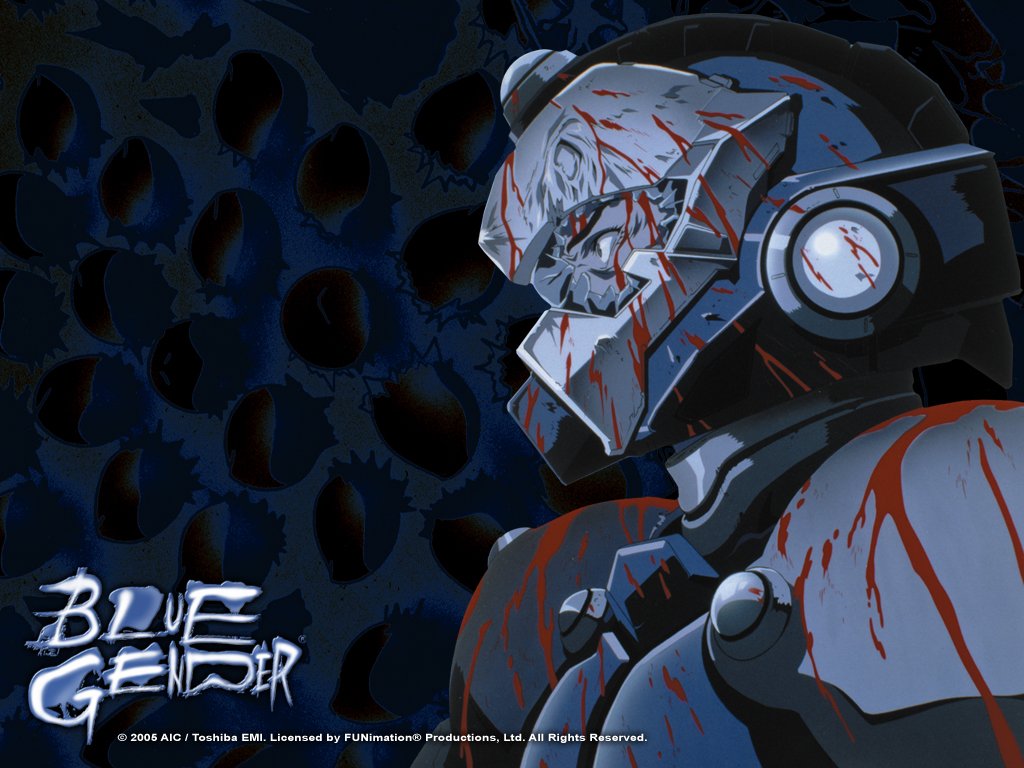
It was just announced that Muv-Luv Alternative is getting an anime adaptation, and since with my divine clarity I can easily tell that an adaptation of a 50+ hour long visual novel is definitely going to be nothing short of a disaster, I instead decided to write about what I considers to be the closest thing we’ll ever get to a good Muv-Luv anime, and the best thing about it, it has absolutely nothing to do with the Muv-Luv franchise, I’m talking about the anime, Blue Gender.
Blue Gender is a 26 episodes long 90’s sci-fi mecha drama anime that is completely anime original (not based on any preexisting source material). But why am I recommending this title specifically to Muv-Luv fans? There are a multitude of reasons for that, so let me go over them one by one.
The Premise
Blue-Gender and Muv-Luv Alternative have nearly identical premises and settings: In both works humanity is pretty much screwed and are no longer the dominant species on the planet, as humans are risking extinctions at the hands of an alien force The Blue (Blue Gender)/The Beta (Muv Luv Alternative), in both works humanity has developed mechas to combat the alien menace, but despite this advancement in technology there still doesn’t seem to be any hope for humanity initially in either of the works.
The adversaries, the Blue and the Beta are also nearly identical, both of whom are aliens lacking in any humanity both in appearance and personality, in which they are more bug-like rather than anything else as they live in hives, have various strains/types that do specific jobs/tasks and obey a hive-mind instead of having any sort of individuality. Both the Blue and the Beta also transform Earth and the geography and recycle material as their central goal, even turning captured humans into material.
The only real difference in the setting of the two works lies in the matter of how screwed humanity exactly is in their respective works. In Blue Gender humanity has been pretty much forced out of Earth by the Blue and now exist in a gigantic space station orbiting Earth known as Second-Earth where they occasionally launch futile attempts to try and retake the Earth and accomplish specific objectives, which would initially make it seem like humanity is more screwed in Blue Gender than in Muv-Luv, since in Muv-Luv humanity at least still holds some degree of control over the Earth in larger areas (such as America) and haven’t been forced off the planet just yet, but it is actually the opposite.
From a purely objective/statistical standpoint humanity is much more screwed in Muv-Luv Alternative for a number of reasons. The most obvious being that the Beta also have colonies on Mars and the Moon, so even if they wipe out the Beta on Earth they will still have to deal with the Beta on the other celestial objects, in contrast in Blue Gender the Blue are not capable of interstellar travel and as such are entirely confined to Earth, humanity would only need to wipe out the Blue on Earth somehow to achieve victory, or they could just stop wasting resources trying to retake Earth and make Second-Earth their permanent home since the Blue cannot get there. Nevertheless the fact that humans have been exiled from Earth gives Blue Gender a much more depressing tone from a sentimentalist standpoint.
The Main Characters
The protagonist of Blue Gender, Kaido Yuuji and the protagonist of Muv-Luv, Shirogane Takeru are fundamentally identical in their roles as both of them are out of time and out of place characters in the setting of the story that know nothing about the horror of the worlds they were just put into and as such serve as the crutch for the audience as someone who they can relate to in the story. In Yuuji’s case he was diagnosed with a terminal illness and put into stasis until a cure could be found in the future, but little did he expect to be awoken in a world dominated by the Blue. In Takeru’s case he was pulled from an alternate parallel dimension from his peaceful everyday life into the terrible world of Muv-Luv Alternative. The methods of arrival are different, but both protagonists are essentially foreigners to their settings.
Both main characters undergo a similar character journey where they witness the horrors of their new worlds first-hand and initially try to cope and deny their respective tragedies but eventually they are broken by it, and from that state both characters manage to rise and emerge into a new person with stronger and more resolute character than before that is capable of shouldering their role in the story.
The settings of both Muv-Luv and Blue Gender turn their otherwise ordinary protagonists into saviour figures that can grant hope to an otherwise broken world and hopeless humanity, and in both cases this happens through something that the protagonists bring from their previous ordinary life. In Muv-Luv Takeru obviously brings back Yuuko’s calculations from his old world to the Alternative world’s Yuuko, which enables her to complete the 00 Unit. While in Blue Gender, ironically the same disease that put Yuuji into stasis in the first place is sought after by the humans of Second Earth as a salvation against the Blue menace.
Structure and Tone
While Muv-Luv Alternative undergoes a lot more stages than Blue Gender does, owing to the fact that it is a 50 hour long visual novel with a lot more scenes compared to the 10 hour long Blue Gender anime, the frightening fact remains that if we examine Muv-Luv Alternative’s structure from Marimo’s death then it will be frighteningly identical to the structure of Blue Gender, in which both could be loosely characterized by the following stages that are connected by the same type of emotion present:
Despair – Marimo’s Death and Shirogane’s PTSD/Yuuji’s awakening and first 10 episodes on Earth
Hope – Shirogane’s recovery and the activation of Unit 00/Yuuji’s arrival on Second Earth and the formation of the anti-Blue strike force.
Triumph – Both Muv-Luv Alternative and Blue Gender have humanity triumph over the Beta/Blue in (a) major battle(s) in the first time since forever
Despair – The Beta/Blue make their counterattack and attack the headquarters for the human offensive, inflicting massive causalities, all seems lost.
Desperation – In both works the characters manage to defeat the attacking Beta/Blue, but their losses are too great, causing the humans to change up their plans that ends up with both Yuuji and Shirogane attacking the hive of the Blue/Beta.
Truth and Hope – During the hive attack both Yuuji and Shirogane communicate with the hive mind and learn plot related answers that change everything that happened in the story. Both stories end on a relatively hopeful note as Shirogane’s sacrifice brought humanity decades of time while in Blue Gender the humans who have learned to love are no longer hunted by the Blue.
My expression may be a bit poor, but I do believe that the overall structure of these two works are uncannily similar and that anyone who has finished both works can agree with me to some extent.
As for the tone of the works, while they are for the most part pretty similar, it has to be stressed that Muv-Luv’s gloom and doom is counterbalanced with scenes of lighthearted humour and the banter between the various colourful characters, which makes it much easier to consume compared to Blue Gender which takes itself super seriously in every episode and as a result can be a bit oppressive to watch, especially if binge-watching it. Blue Gender doesn’t really have any comedic or humour scenes to break up the tension, instead the romance between the main characters is used to tone down the constant despair and violence, but even that is used sparingly.
The Theme of Love
Everyone knows that love is a pretty important part of Muv-Luv, likewise it is also of significant importance in Blue Gender. The two main characters’, Yuuji’s and Marlene’s developing romance throughout the course of the story is one of the most pivotal aspects of Blue Gender’s message. Soon after Yuuji awakens in the future, the viewer is presented with the fact that love has ceased to exist among the humans that are struggling to survive, and even sex, the act of making love has become a cold and emotionless process meant to provide nothing but instant gratification.
In a sense, it is Yuuji who brings love back to humanity from his old world with his old world sensibilities by warming up the initially cold, super serious and stern Marlene and making her fall in love with him throughout their journey to Second Earth, however in the second act of the story the reverse happens as Yuuji starts losing his humanity due to the corrupting influence of the Blue, it is Marlene’s love that pulls him back from the depths and saves him from insanity, in essence both main characters heal each other throughout the course of the story and become people that genuinely need each other, and as they learned to love, they will be among the ones spared in the end.
Differences
While Muv-Luv and Blue Gender are pretty similar works, there are still some differences in the two that I must mention.
One of the biggest differences is in regards to Cast and Characters, Muv-Luv has a large and colorful cast that are full of life and are very likeable to the reader because they were built up for 3 visual novels (or even more if you count the non-Muv-Luv VN characters like the Kimi Ga Nozomu Eien cast) and their presence really helps creating some lightheartedness in an otherwise serious and often somber story.
In contrast only two characters really matter in Blue Gender and they are Yuuji and Marlene. There are other characters beyond them sure, but it is first and foremost their story and other characters pretty much only exist to support or oppose their journey. I would argue that this is not really a flaw but rather than asset to Blue Gender as it makes these two characters much stronger, but it also has the effect of making the viewer less invested in the fate of other characters and the tragedies that happen to them. The fact that Blue Gender is told from a 3rd person’s perspective rather than Muv-Luv’s 1st person perspective also contributes to the viewer being overall more detached and less involved from the events of the story than while reading Muv-Luv.
The second notable big difference and one that actually makes Blue Gender somewhat infamous is the fact that Blue Gender compared to Muv Luv, is quite preachy. It clearly has messages and it has no qualms wearing those messages openly on its sleeve, and its message is something many or most viewers might not agree with it and is also something that might detract from the enjoyment of the story depending on the personality of the viewer.
I don’t want to go into full detail because it would spoil the story, but humanity is painted in quite a bad light in Blue Gender, everything that happens to them in the anime is their own damn fault and even in the face of Armageddon humanity hasn’t managed to put aside their petty differences, their worst traits are on full display instead, and when humanity actually starts making successful victories against the Blue, it is framed in such a way that is meant to make the viewer kind of pity the insectoid Blue as they are portrayed completely helpless for the first time in contrast to the humans that are portrayed as bloodthirsty and savage who are losing their humanity through their victories, as if saying that if humanity were to triumph over the Blue they would become something even worse than them.
One might even simplify it that the moral of Blue Gender is “NATURE GOOD. TECHNOLOGY BAD.” and given how the story ends that isn’t even a hard conclusion to reach and while Muv-Luv also had its messages sure they certainly weren’t in any way preachy about it nor were they this unsubtle in the delivery.
Conclusion
Blue Gender is definitely one of a kind mecha anime that I think is a great treat to both fans of the genre and fans of Muv-Luv Alternative due to the similarities of the two works, though some aspects of Blue Gender such as its preachiness and its controversial ending may be a bit hard to forgive or stomach for the average viewer.
If you are going to watch it just make sure to watch the TV series and not the movie (Blue Gender Warrior), because that one is just an awful summary compared to the TV series.




 Eggplant Club